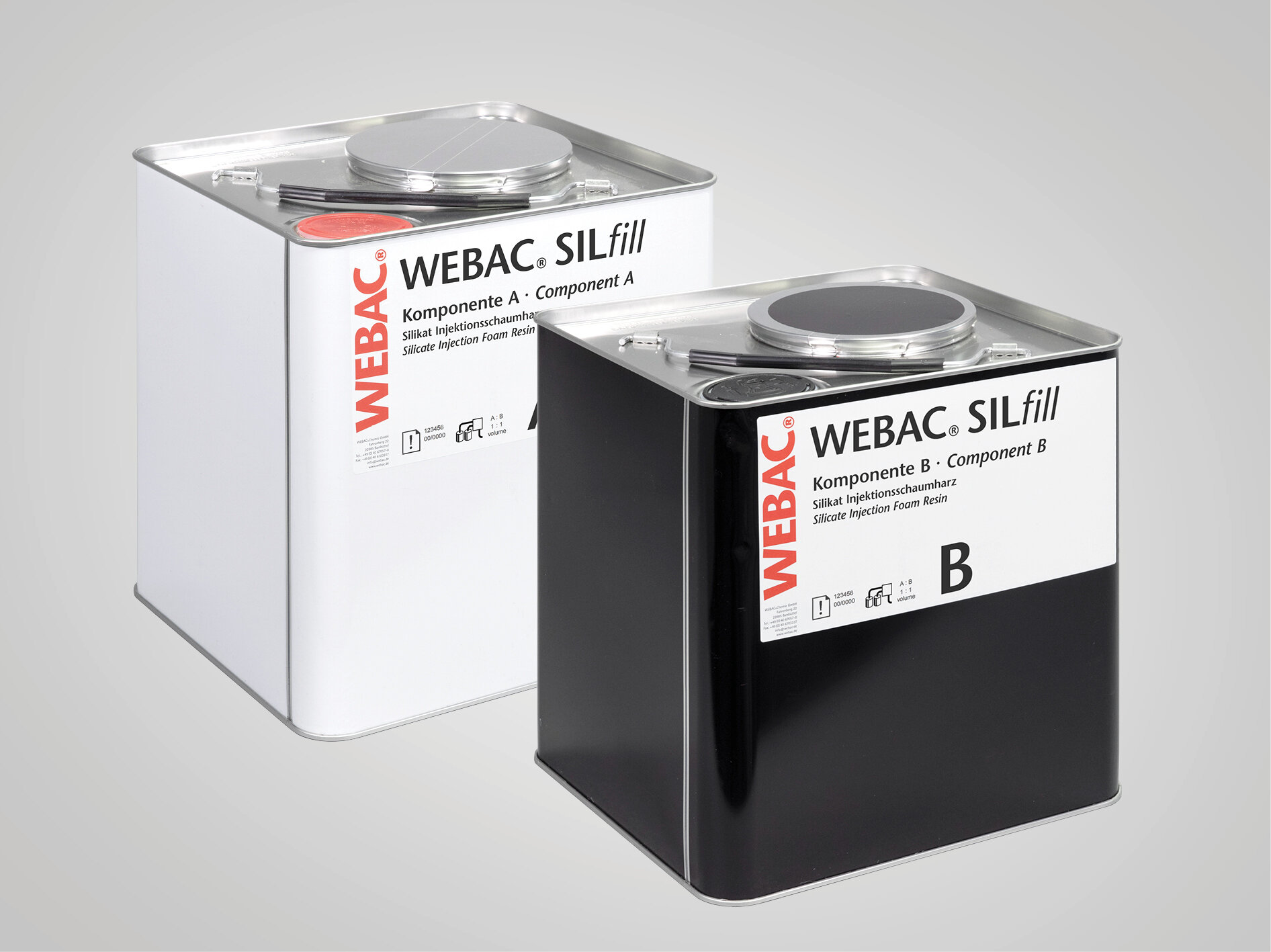
WEBAC® SILfill
WEBAC SILfill is a low-viscosity silicate injection foam resin. Even without contact with water, it forms a fine-celled foam with a high expansion ratio and cures quickly into a material that can be cut and planed. The resin is used for shield injection in the immediate vicinity of TBMs, as well as for subsoil stabilization and rock reinforcement.


![[Translate to English:] Wasserstop- und Volumenersatzsystem bei kleineren Hohlräumen](/fileadmin/_processed_/8/c/csm_Wasserstopp-Volumenersatz_045c25bf4a.png)
![[Translate to English:] Ortsbrustverfestigung](/fileadmin/_processed_/d/2/csm_Vorfeldinjektion-Ortsbrustverfestigung_f7d46996ff.png)
- Umbrella injection in direct TBM areas
- Reinforcement ahead of the tunnel face and tunnel face
stabilization - Quick filling of cavities/voids, also in mining
- Reinforcement ahead of the tunnel face and tunnel face
- Subsoil and rock mass stabilization
- Soil solidification and stabilization in earthworks and dam
building, especially in case of sandy formations - Slope stabilization
- Solidification of karst and unconsolidated rock, gravel and
crushed rock layers
- Soil solidification and stabilization in earthworks and dam
- Sealing of foundation pits and tunnel systems
Properties
- Silicate-based injection foam resin
- High foaming factor and fine cellular structure
- No water required for foam reaction
- Suitable for cutting and planing
- Low viscosity
- Short reaction times
- Environmentally sound
Techical Data
| Density, 23 °C DIN ISO 2811 | Comp. A | ≈ 1.17 g/cm³ ≈ 1.23 g/cm³ | ||||||
| Viscosity, 23 °C DIN ISO 3219 | Comp. A | ≈ 150 mPa.s ≈ 180 mPa.s | ||||||
| Foam reaction Building structure and material |
| 12 °C ≈ 20 s ≈ 60 s ≈ 35 times | 23 °C ≈ 10 s ≈ 43 s ≈ 35 times | 30 °C ≈ 8 s ≈ 35 s ≈ 30 times |
Downloads & Documents
Technical Data Sheets|PDF
WEBAC® SILfill
Direct download:
Safety Data Sheets|PDF
WEBAC® SILfill Comp. A
Direct download:
Safety Data Sheets|PDF
WEBAC® SILfill Comp. B
Direct download: